With software, "what does it cost?" is rarely a question about a single number. A licence price
per user is easy to find; what a firm ends up paying depends on the number of employees, the
modules actually used, and the time setup takes. Below are those items in practice, with a
worked example per firm size.
The licence
Offsoo charges a base amount for one user plus an amount per additional user. There are two
compositions:
- Planning — €64.95 per month for the first user, €12.95 per additional user.
- Planning and time tracking — €74.95 per month for the first user, €15.95 per additional
user. This is the most commonly chosen composition.
The subscription can be cancelled monthly, and current amounts are on the pricing page.
A worked example per firm size
Based on Planning:
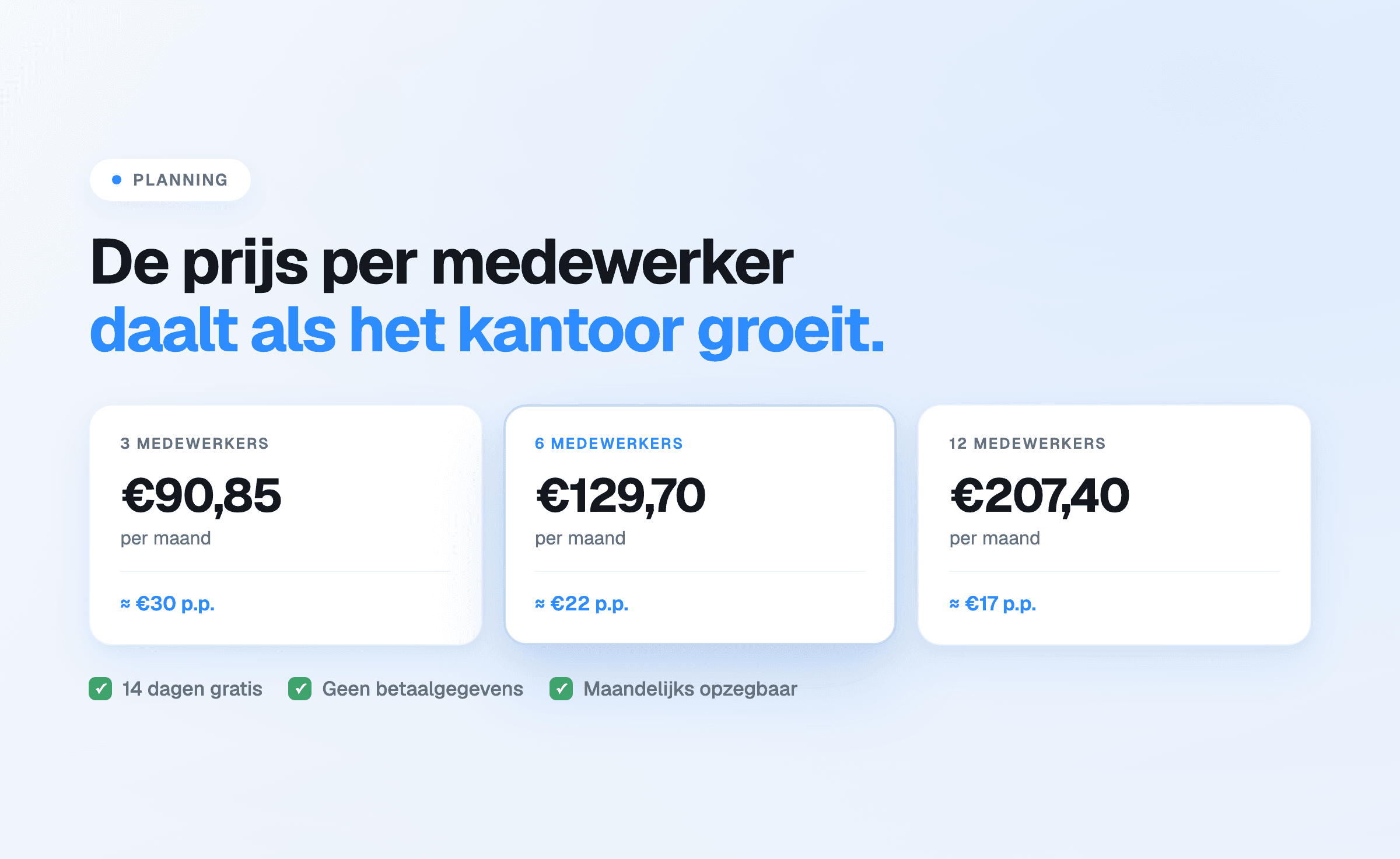
- A firm with 3 employees — €64.95 + 2 × €12.95 = €90.85 per month, roughly €1,090 per
year. That works out at about €30 per employee per month.
- A firm with 6 employees — €64.95 + 5 × €12.95 = €129.70 per month, roughly €1,556 per
year, or about €22 per employee per month.
- A firm with 12 employees — €64.95 + 11 × €12.95 = €207.40 per month, roughly €2,489 per
year, or about €17 per employee per month.
Because only the first user carries the base amount, the price per employee falls as a firm
grows. That is the opposite movement from packages charging a flat rate per user.
Adding time tracking costs €10 more for the first user and €3 per additional user: in a
six-person firm that comes to €25 a month.
The costs that are not on the invoice
Two items are structurally underestimated when choosing software.
Setup. Clients, activities and frequencies have to be recorded once. For a firm with a few
hundred files that is a matter of hours, not weeks — the client list comes in through an import,
and recurring activities are configured per type of work rather than per client. Expect half a
day to a day, spread over a few sessions.
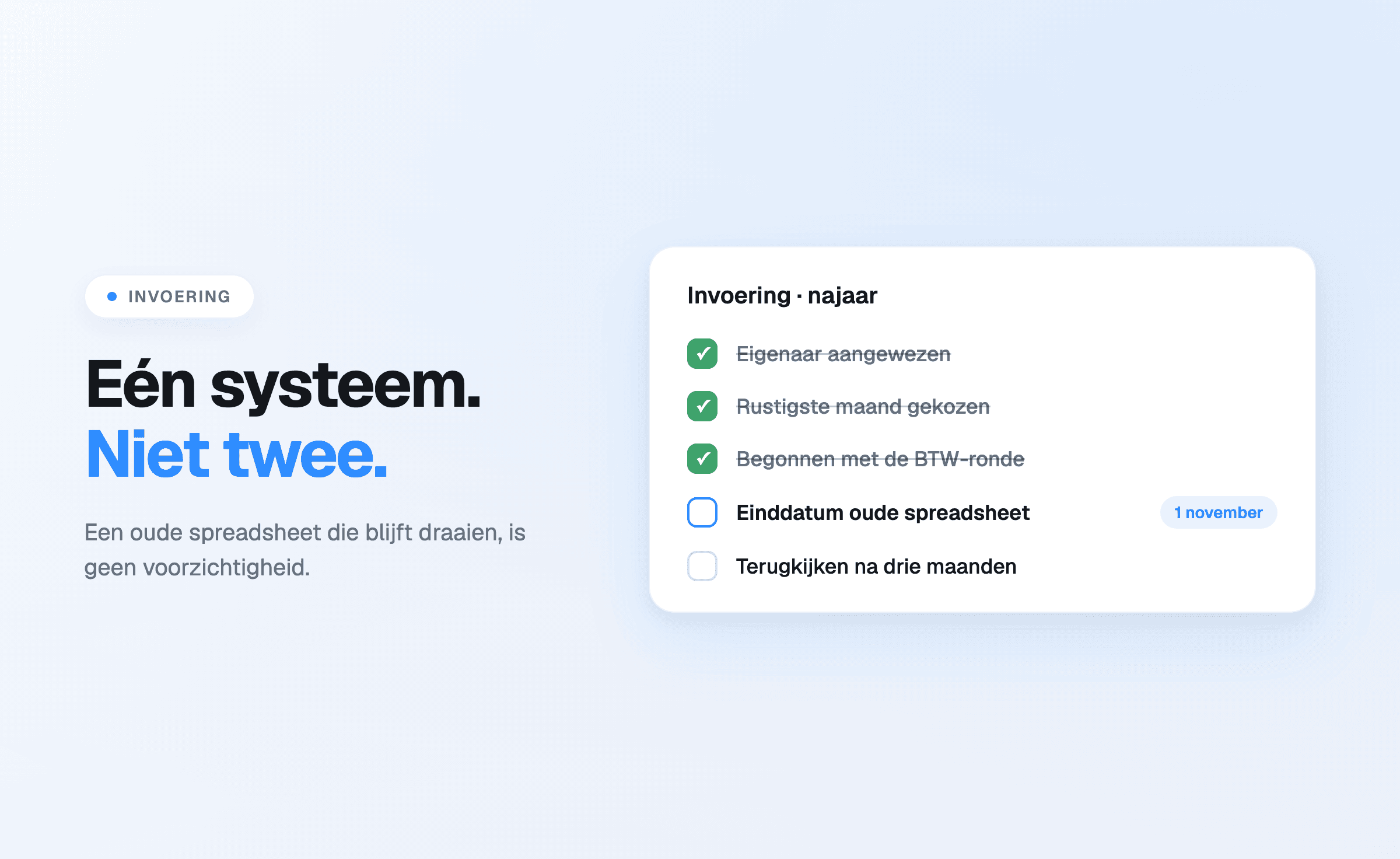
Adjustment. The first round in new software runs slower than in a familiar spreadsheet. That
effect is real and temporary; it usually lasts one period. A firm switching in the middle of the
year-end peak makes it needlessly hard on itself — the quietest month is the cheapest moment.
What does not get added: purchase costs, installation, maintenance or a mandatory implementation
programme.
What it stands against
The return on planning software is harder to capture in one figure than the cost, but three items
are concrete enough to calculate for any given firm.
- Unrecorded hours. Hours reconstructed from memory afterwards almost always come out lower
than what was actually spent. Two hours per employee per month is a conservative assumption; at
an hourly rate of €85, that is more than €12,000 a year in a six-person firm.
- Work done twice. A task picked up twice because it was not visible that a colleague had
already finished it costs nothing in licence fees and a lot in time.
- Overtime born of invisibility. A month that is planned too full can be spotted in advance,
and afterwards can only be solved with evenings.
Payback time differs per firm. The calculation is always the same, though: set the annual licence
against the number of hours a firm spends each month on maintaining lists, chasing status and
redistributing work.
What to watch when comparing
Package prices are rarely comparable one to one. These points make the difference:
- Per user or per firm? With a per-user rate, the bill grows linearly with the team.
- What is included in the base? Time tracking, client management and reporting are separate
modules in some packages.
- Contract term. Cancellable monthly or an annual contract with a notice period — that
difference weighs more than a few euros per month.
- Setup or migration fees. Ask explicitly whether an implementation programme is mandatory.
- Getting out again. An export of clients, hours and planning to Excel, CSV or PDF should be
a given. Data that cannot come along makes the next choice more expensive.
Try it first
The cheapest way to judge a price is to put it next to the actual work. The Offsoo trial runs for
14 days, needs no payment details and includes a demo environment with sample data, so there is
something to look at before the real client list goes in.
Start a free trial, review the
pricing or book a
demo.