Ask at a firm why an earlier change of software did not work out, and the answer is rarely about
the software. It is about the timing, about the colleague who was going to carry it and left, or
about the spreadsheet that was kept up "just in case" and was still there two years later.
This article is therefore not about choosing a package, but about the conditions under which an
introduction succeeds.
Why introductions break down
There is no owner. Software without someone responsible for it becomes everyone's and therefore
nobody's. The owner does not have to be the most technical colleague; it has to be someone allowed
to make decisions about how the firm works.
The moment is badly chosen. The first period in new software runs slower. That is normal and
temporary, but starting in the busiest month makes it feel like proof that it does not work.
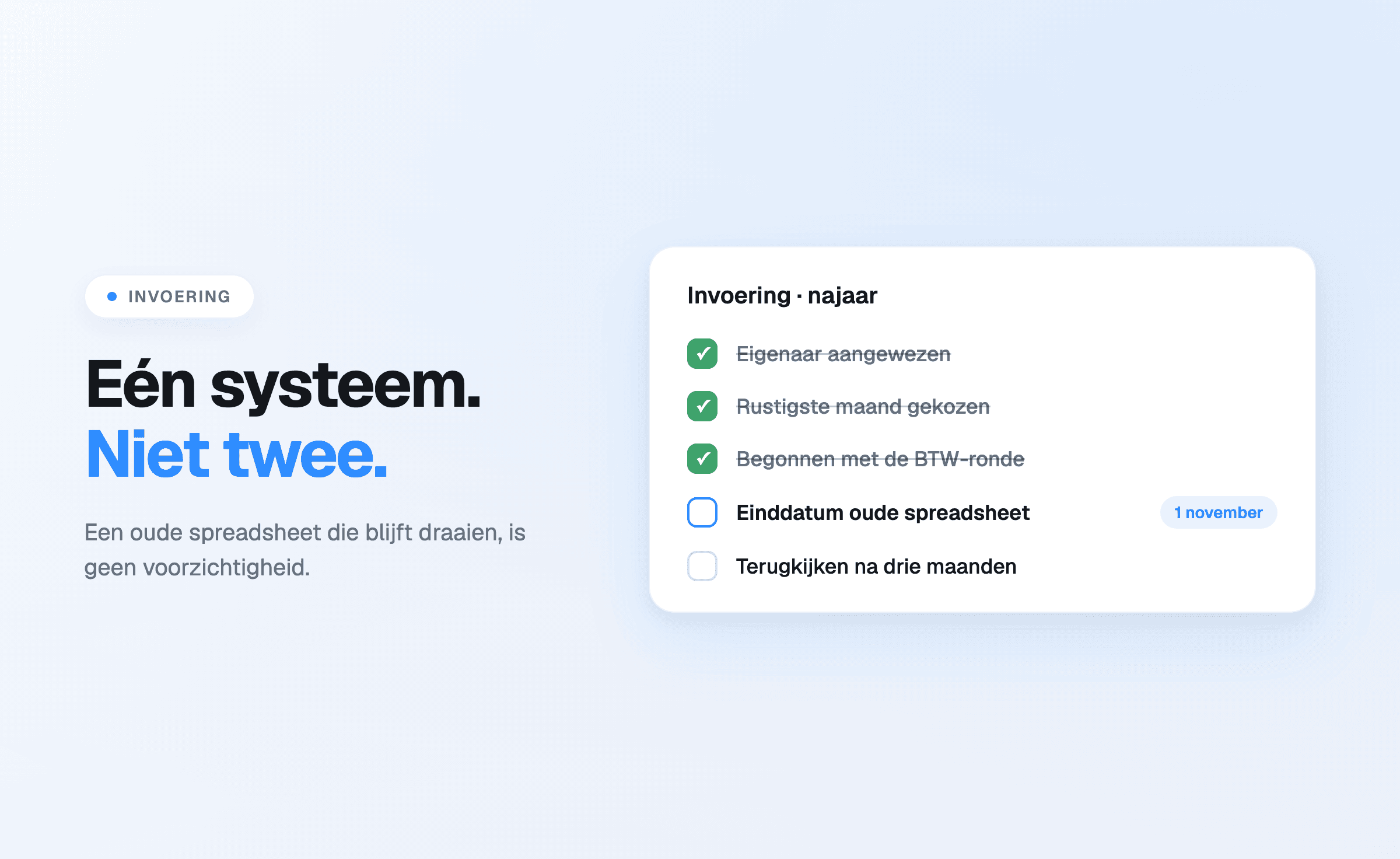
The old system keeps running. As long as the old spreadsheet is still maintained, there is no
reason to trust the new environment. Two systems side by side is not cautious; it is more expensive
and less reliable than one.
Three questions before choosing
Which problem has to go? "More overview" is a wish, not a problem. "Twice a quarter a return
turns out not to have been filed" is a problem, and it is measurable. Without a concrete problem
there is nothing to test afterwards.
Who has to work with it? Software used only by management changes nothing about the daily work.
It is worth knowing in advance what the colleague running the VAT round expects from it.
What goes away? An extra system is an added burden. Every introduction comes with the question
of which list, which file or which action is dropped.
The introduction itself
- Pick the quietest moment. For most firms that is summer or autumn, well before the year-end
peak and not just before a filing deadline.
- Start with one type of work. The VAT round suits that best: it is predictable, it touches
nearly every client, and the effect shows within a single quarter.
- Configure per type of work, not per client. Ten to fifteen recurring activities cover most of
the work; the client list comes across through an import. The sequence is described in
getting started in four steps.
- Agree one date on which the old file stops. Not "we will wind it down gradually", but a date
after which the planning exists only in the new system.
- Let the team run the first round together. Half an hour at the start of the period and half
an hour at the end delivers more than training beforehand.
What helps with adjustment
Resistance to new software is rarely about buttons. It is about whether the work becomes visible in
a way it was not before — and that is a conversation best held explicitly.
It helps when the system gives something back to the person filling it in. Time tracking that only
feeds invoicing feels like supervision; the same tracking that reveals an activity is structurally
under-planned hands its user an argument.
It also helps when the terminology is right. Software speaking of assignee, activity, filing period
and account manager needs no translation. In the early days that saves more than a manual.
Looking back after three months
Put one moment in the calendar, three months after the start, with three questions:
- Has the problem from the first question got smaller, and how can that be seen?
- Is anything still being kept outside the system, and why?
- Which action now takes more time than before?
That last question is the most important. There is almost always one thing that has become more
cumbersome, and naming it prevents a shadow list from quietly appearing.
Start a free 14-day trial or book a
demo to go through the introduction together.