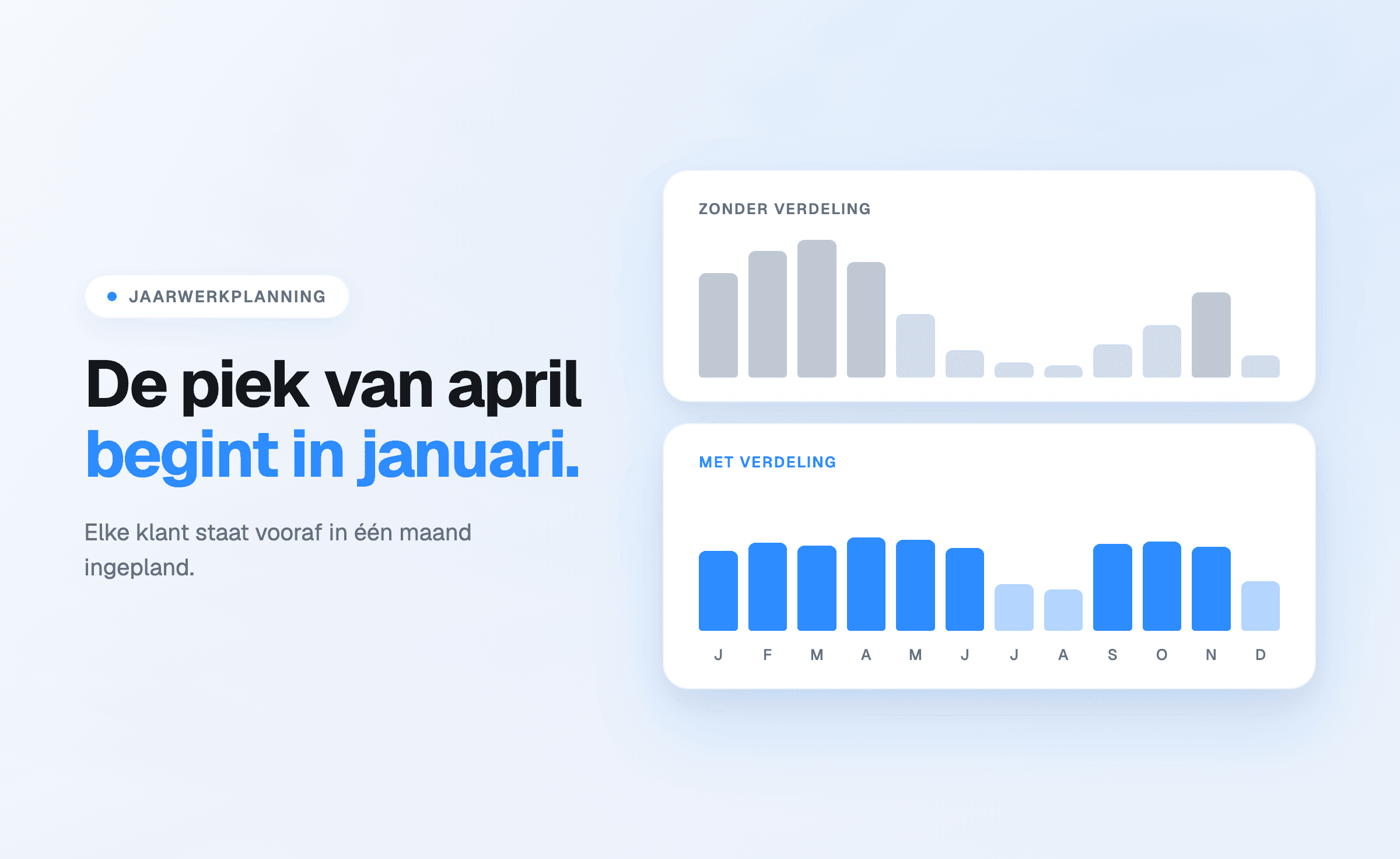
At most firms, year-end work is not spread evenly across the year. January through May fills
up, summer is quiet, and autumn brings a second peak of files that were left behind. That
pattern is rarely a capacity problem. It is a planning problem: year-end work only gets a slot
in the calendar once the documents come in.
A year-end plan reverses that. The distribution is fixed at the start of the year — per client,
per month, with an assignee and an hours estimate attached — and delivery follows that
distribution instead of the other way around.
Why year-end work piles up on its own
Three mechanisms reinforce each other.
Delivery dictates the order. Whoever delivers first gets handled first. That is
understandable, but it means the firm's planning is set by clients' bookkeeping rather than by
available capacity.
The deadline is the same for everyone. Without internal milestones, everything falls back on
the statutory date. A file that could have been finished in September then sits just as long as
one that is only complete in March.
Overrun stays invisible until it is too late. When nothing shows how many hours are still
open for the remaining year-end work, the backlog only surfaces once the weeks are already
full.
What spreading means in practice
Spreading is not the same as starting earlier. It means cutting year-end work into blocks and
giving each block its own month.
For a firm with a few hundred files, a workable distribution looks roughly like this:
- January through March — files that are already complete or kept up monthly. Those can go
straight through.
- April through June — the largest block: clients who can deliver after the fourth-quarter
VAT return.
- July and August — deliberately light because of holidays, with a small buffer for
whatever slipped.
- September through November — the files that are structurally complete later, plus the
first checks for the next year.
- December — no year-end work, but preparation: reviewing the client list and fixing the
distribution for the coming year.
The exact division differs per firm. The principle does not: every client is scheduled in one
month up front, and that month is known to both the assignee and the account manager.
Four steps to a year-end plan that survives the year
1. Set year-end work up as a recurring activity
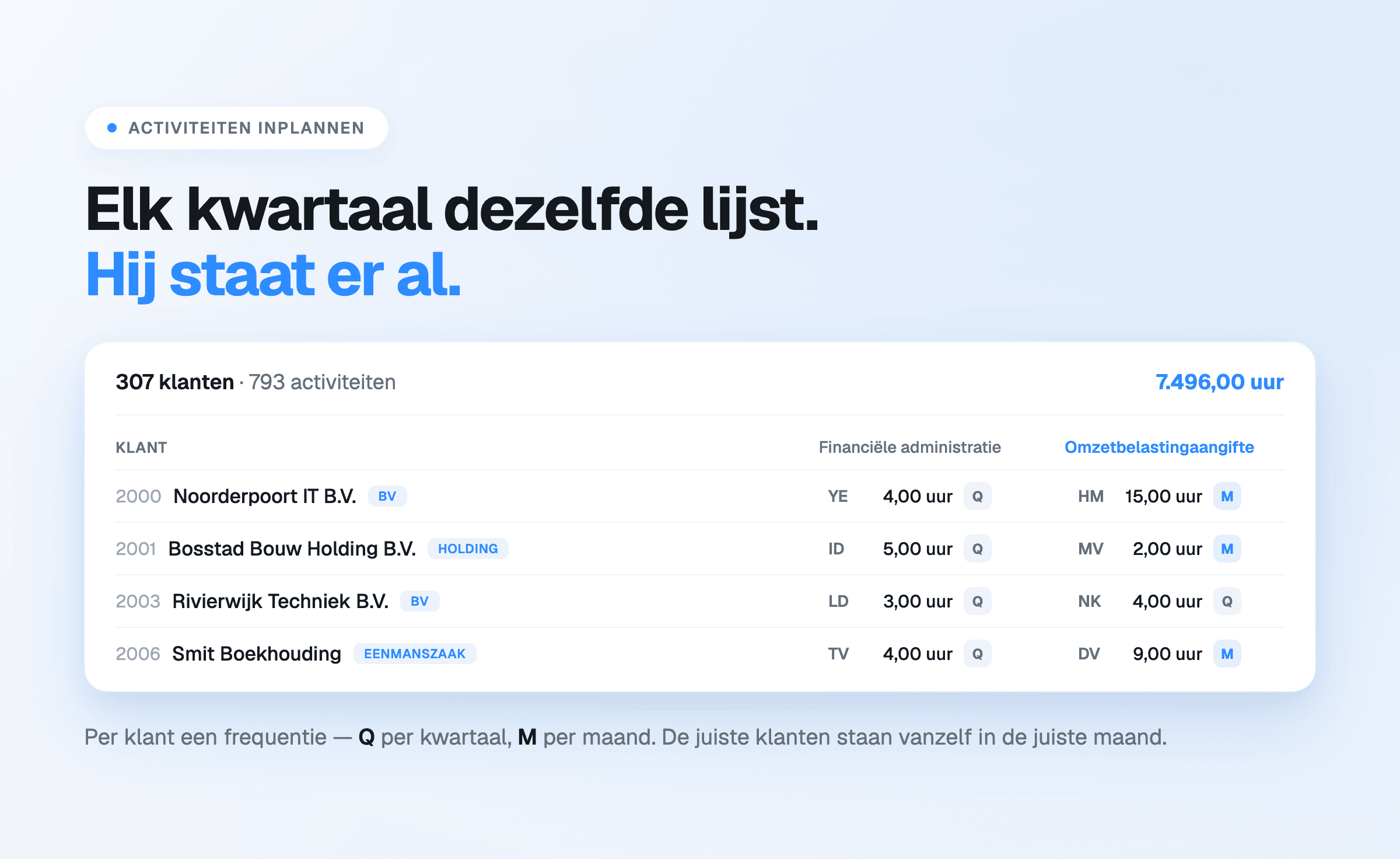
Year-end work is recurring work by definition. In Offsoo it sits in the planning grid as an annual activity: configured once per client, after
which it reappears every year with the same assignee, the planned hours and the matching checklist of steps. That
removes the yearly chore of rebuilding lists, and it prevents a file from dropping out of sight when things get busy.
2. Give every client a month, not a deadline
The annual planning has a dedicated Month column for this: per client it records which month
the year-end work is handled in. Firms that want to plan more finely can switch that column to
weeks. What matters more than the exact division is that every client sits in exactly one month. A
list of thirty files that all need to be done "before summer" is not a plan.
3. Attach hours
Without an hours estimate, a distribution cannot be tested. Once planned hours sit on each
activity, it becomes visible what a month costs and whether that fits the team's available
hours. A month holding 340 hours of year-end work against 260 available hours is better moved
now than in April.
4. Let delivery follow the plan
The distribution is only worth something once clients know about it. A firm that communicates in
January which month a file will be handled in — and which documents need to be in by when —
shifts the delivery pattern along with it. That is the step with the largest effect and the one
most often skipped.
What becomes visible once year-end work sits in the planning
Once year-end work is an activity in the planning instead of a row in a spreadsheet, what
changes most is what can be read from it:
- how many files are open per month and what status they are in;
- which assignee is full in which month and who still has room;
- which files have been pushed forward twice — those are rarely files that resolve themselves;
- how many hours were spent against the estimate, per client and across the whole year-end run.
That last one is the most useful for the following year. A distribution that looked right on
paper in January but cost 20 percent more hours in practice is worth correcting before the same
distribution is locked in again.
What it delivers
A spread year-end plan does not make the work smaller. It makes it predictable. The difference
shows up in three places: the peak gets lower, summer becomes usable, and the conversation with
a client about delivery is about an agreed month rather than an approaching deadline.
For firms currently planning in Excel, the switch itself is more straightforward than expected:
the client list and the distribution usually already exist, they just sit in a file nobody
updates in between. How that setup runs is described in getting started in four steps.
Curious what a year-end plan looks like with a real client list in it? The trial runs for 14
days and needs no payment details.
Start a free trial or book a
demo.