By giving the filing its own place in the year planning: a month and an assignee per client, apart
from the annual accounts. Two terms apply in the Netherlands: within eight days of adoption,
and no later than twelve months after the end of the financial year. For financial year 2025, 31 December
2026 is therefore the outer limit, not the date of every client.
In late November the question comes up at the firm: which annual accounts for 2025 still have to go to
the KvK (the Dutch Chamber of Commerce)? The answer is scattered: some wait for the client's signature,
some for the annual accounts themselves, and some have already been filed. Without an overview, that
means going through the files one by one.
Which terms apply?
The KvK names two (Uiterste datum deponeren jaarrekening, updated 10 November 2025, in Dutch):
- Within eight days of adoption. Once the annual accounts are adopted, they are filed within eight
days.
- No later than twelve months after the end of the financial year. For a financial year equal to the
calendar year, that is 31 December of the following year. For a different financial year, the twelve
months count from the end of that year.
The first term is why the date differs per client: it depends on the moment of adoption.
For a BV the latest date also depends on the situation, such as the extension the shareholders granted; the KvK lists those situations on the same page. And not every client has a filing duty: a sole proprietorship, for example, does not (Jaarrekening wel of niet deponeren, updated 26 August 2025, in Dutch).
This article is about the planning, not about the rules. Which date applies to which client is for your
firm to judge.
Why filing deserves its own place
Filing is the last step of a long row: administration complete, annual accounts prepared, reviewed,
discussed, signed. It also depends on something your firm does not control: adoption by the client.
That mixes two questions:
- Are the annual accounts done? That is your firm's work.
- Have they been filed? That is only possible after adoption.
If filing is the last step inside the annual accounts, you can only answer the second question file by
file. As its own activity, you see it for all clients at once: who does it, which month it is planned for
and how far along it is.
What that looks like in the year planning
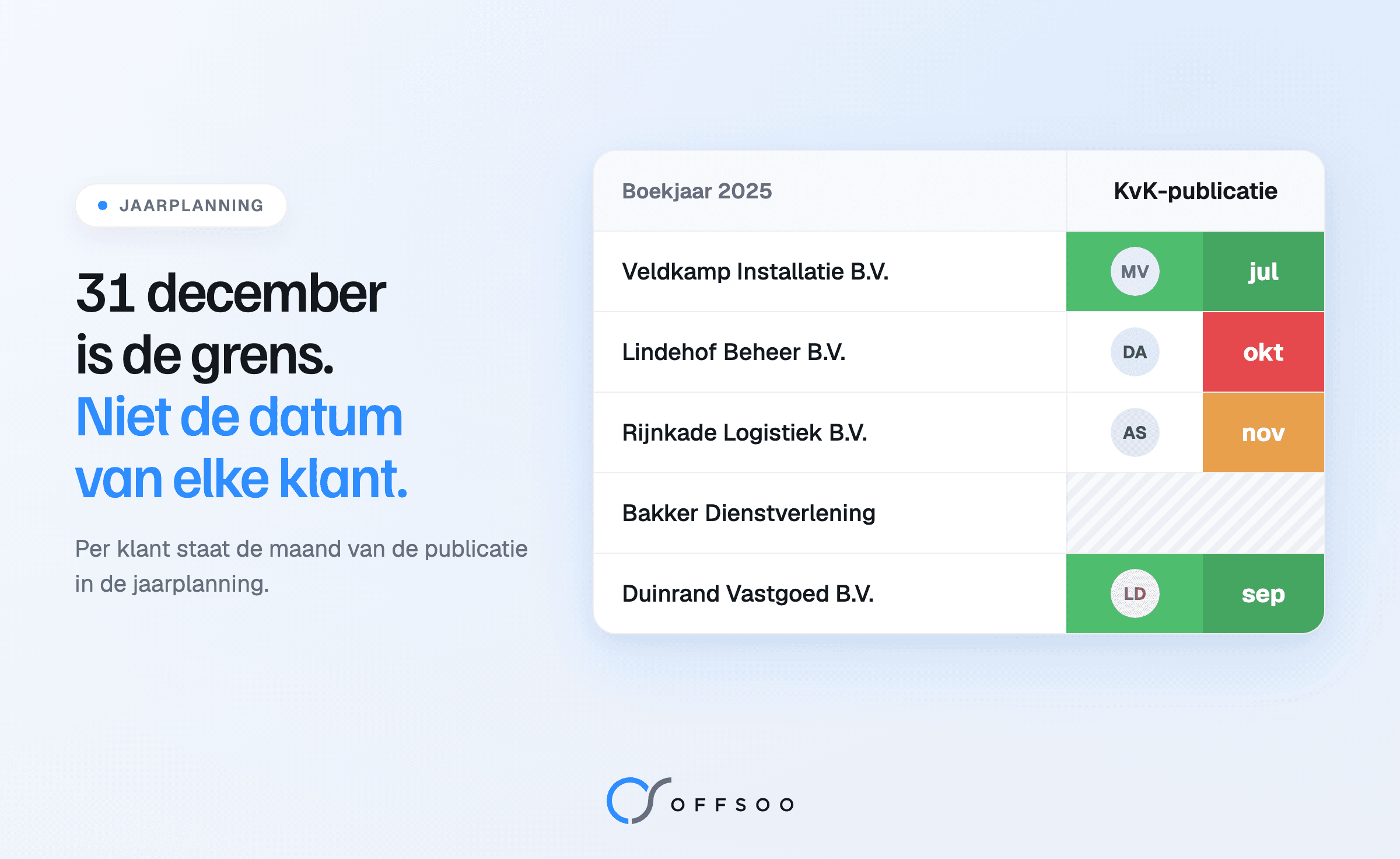
In Offsoo, planning software for accounting firms, the year planning is a grid: every row is a client, every column a yearly activity. A new workspace starts with, among others, the activities Jaarrekening (annual accounts) and KvK-publicatie (KvK filing). Every firm changes the names, the statuses and the steps to its own. If your column has another name, everything below works the same.
A client's cell shows:
- on the left, the assignee's code;
- on the right, the number of the planned month, or of the week if your firm uses week planning;
- the colour of the status. A white cell has no status yet.
Next to the number there is a red dot when the planned month has passed and the work is not completed,
and an orange dot when the work is due this month. A month that is still to come has no colour. A client
for whom the activity is not planned has a grey striped cell; that fits a client that does not have to
file.
The image with this article is a simplified drawing of that column.
Which month per client?
Per client and activity you set the month (the field "Uitvoeren in", carry out in) and the assignee (the
field "Verantwoordelijke"). The year planning plans by month or by week; you cannot set a day or a latest
date per client.
Which month fits is up to your firm. Two ways are in use:
- The month in which that client's annual accounts are completed, or the month after. The filing then
follows the annual accounts, and the work is spread across the year.
- One fixed month at the end of the year. All filings are then together.
Both work. The difference is the moment at which the planning shows a colour. A filing that is planned for
December and not yet completed is orange in December and only turns red after that.
How to set the month and the assignee is in the help centre (in Dutch): De planning van één klant aanpassen. For many clients at once, use the planning assistant.
Seeing what is still open
Three things give you the overview at the end of the year:
- The progress above the column. Above every activity you see which percentage is completed.
- The filter under the column name. Type "Afgerond" (completed) under Jaarrekening and you keep only
the clients whose annual accounts are completed. The KvK-publicatie column then shows where the filing
is still white.
- A status for waiting on the client. If your firm first sends the publication documents to the client
for signing, you can create a status of your own for that. Then you also see which filings are with the
client.
Whether "Afgerond" on the annual accounts means that the work at your firm is done, or that the client has
adopted the annual accounts, is for your firm to agree on.
Searching and filtering are explained step by step in Zoeken, filteren en exporteren in de planning; statuses in Statussen aanmaken en wijzigen (both in Dutch).
What Offsoo does not do here
Offsoo does not file annual accounts and does not calculate terms. Filing happens in the software or
portal your firm uses for it. The year planning keeps track of which client still needs it, in which
month, and who does it.
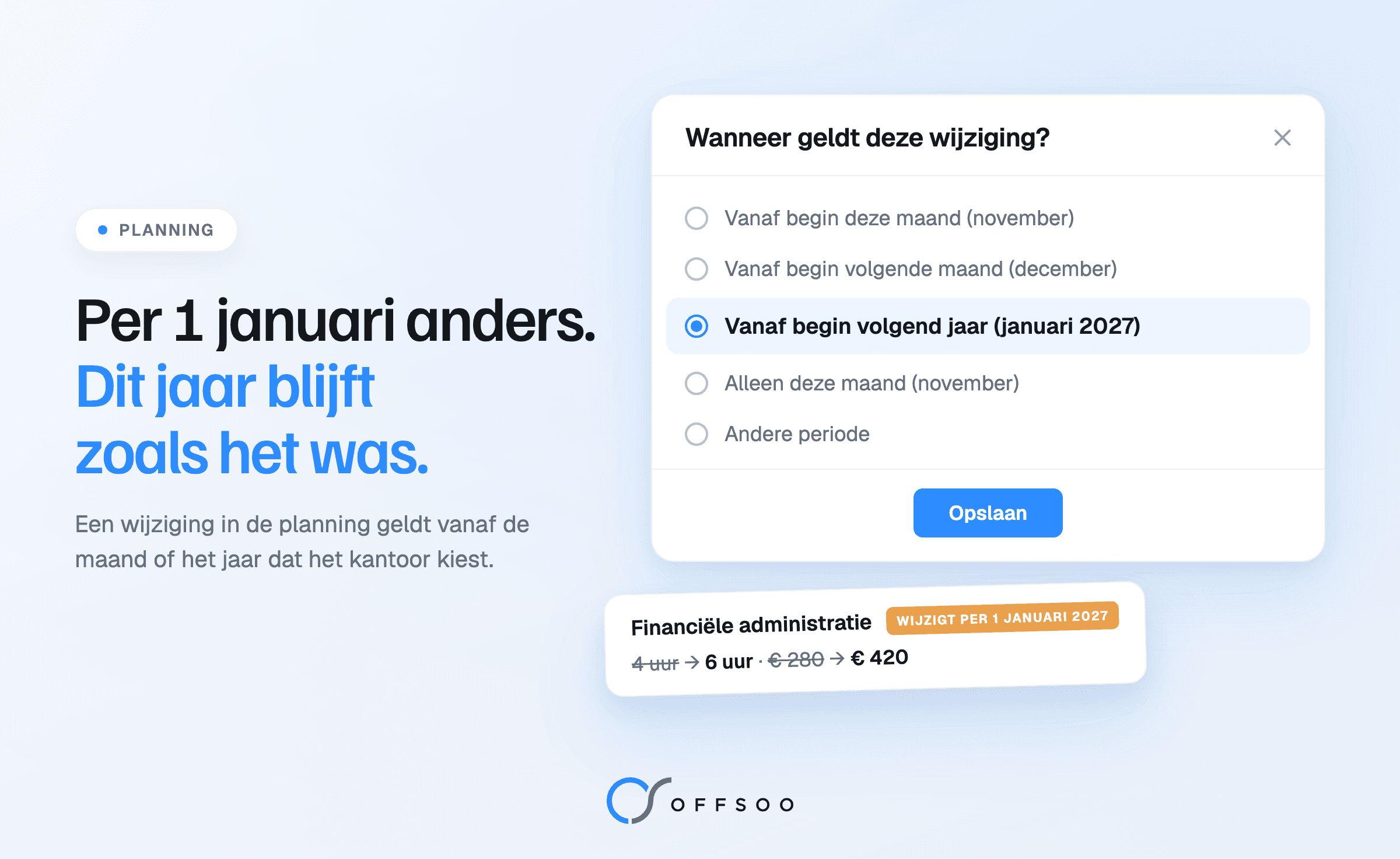
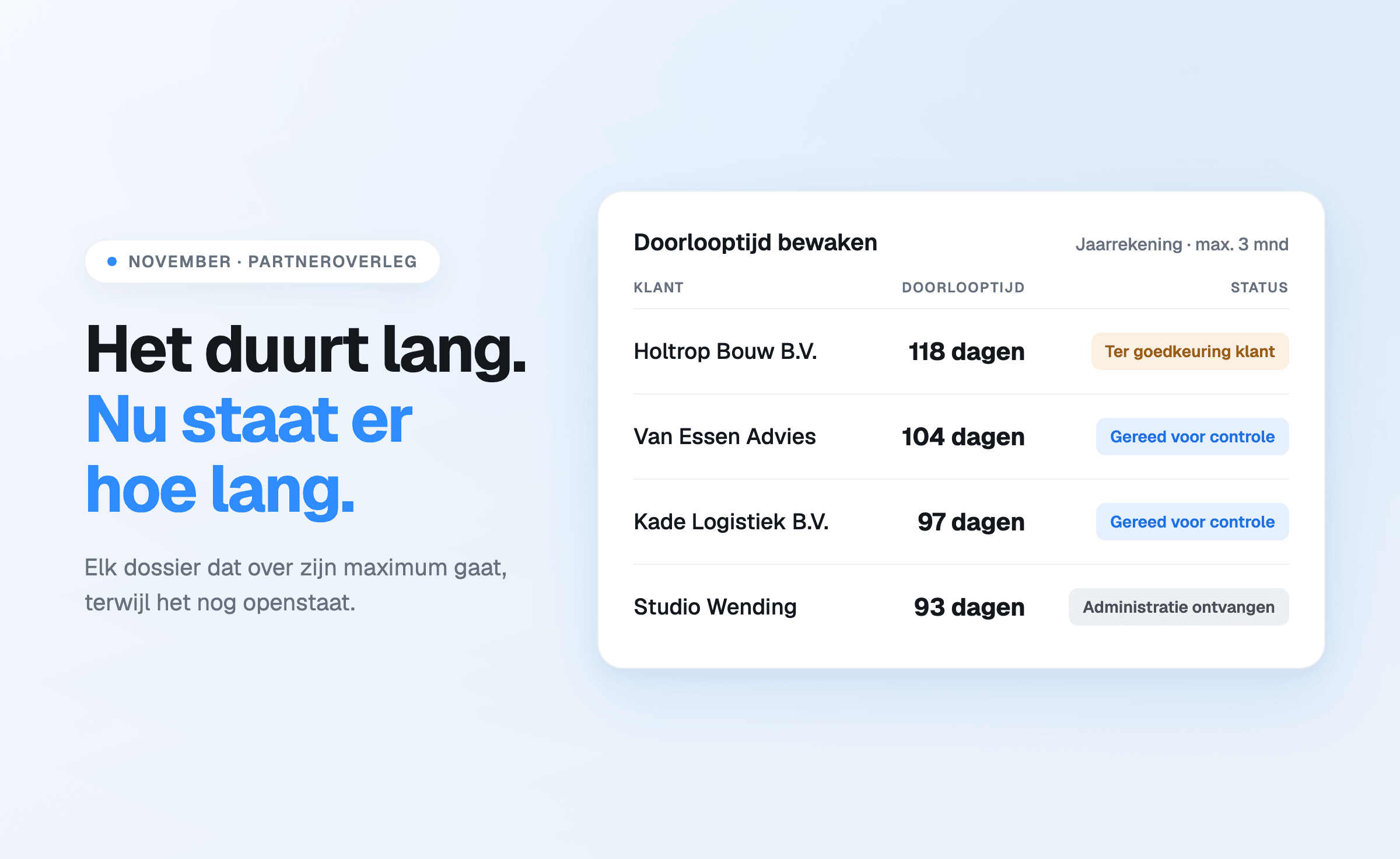
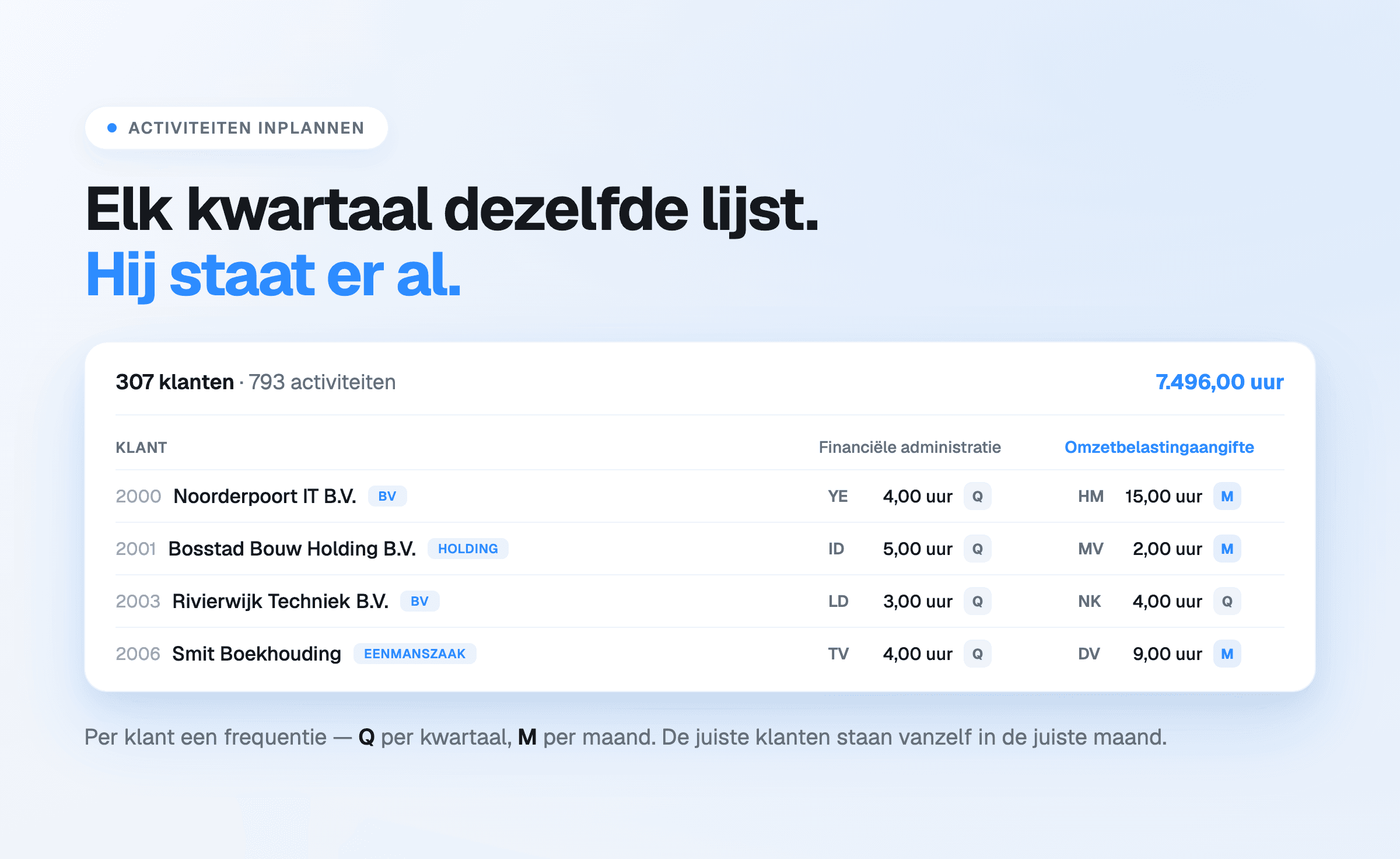
How long a file is open and who it waits for is covered in monitoring lead time. Spreading the annual work across the months is covered in spreading the annual accounts across the year, and setting another month for next year in changing a client's planning from 1 January.
Frequently asked questions
Is 31 December the latest date for every client?
No. For a financial year equal to the calendar year, 31 December is the outer limit of twelve months. Within it, the term of eight days after adoption applies, and for a BV the latest date depends on the situation. The KvK describes which date applies when: Uiterste datum deponeren jaarrekening (in Dutch).
Can you set a day or a latest date per client in the year planning?
No. The year planning plans by month, or by week with week planning.
Does filing have to be its own activity?
No. It can also be a step of the annual accounts. It then has no column of its own, and so no month,
assignee and status of its own.
Our column is not called KvK-publicatie. Does that matter?
No. Your firm chooses the name of an activity; the planning works the same.
Does Offsoo file the annual accounts with the KvK?
No. Offsoo keeps track of which client still needs it, in which month, and who does it.
Start a free trial of 14 days or plan a
demo.