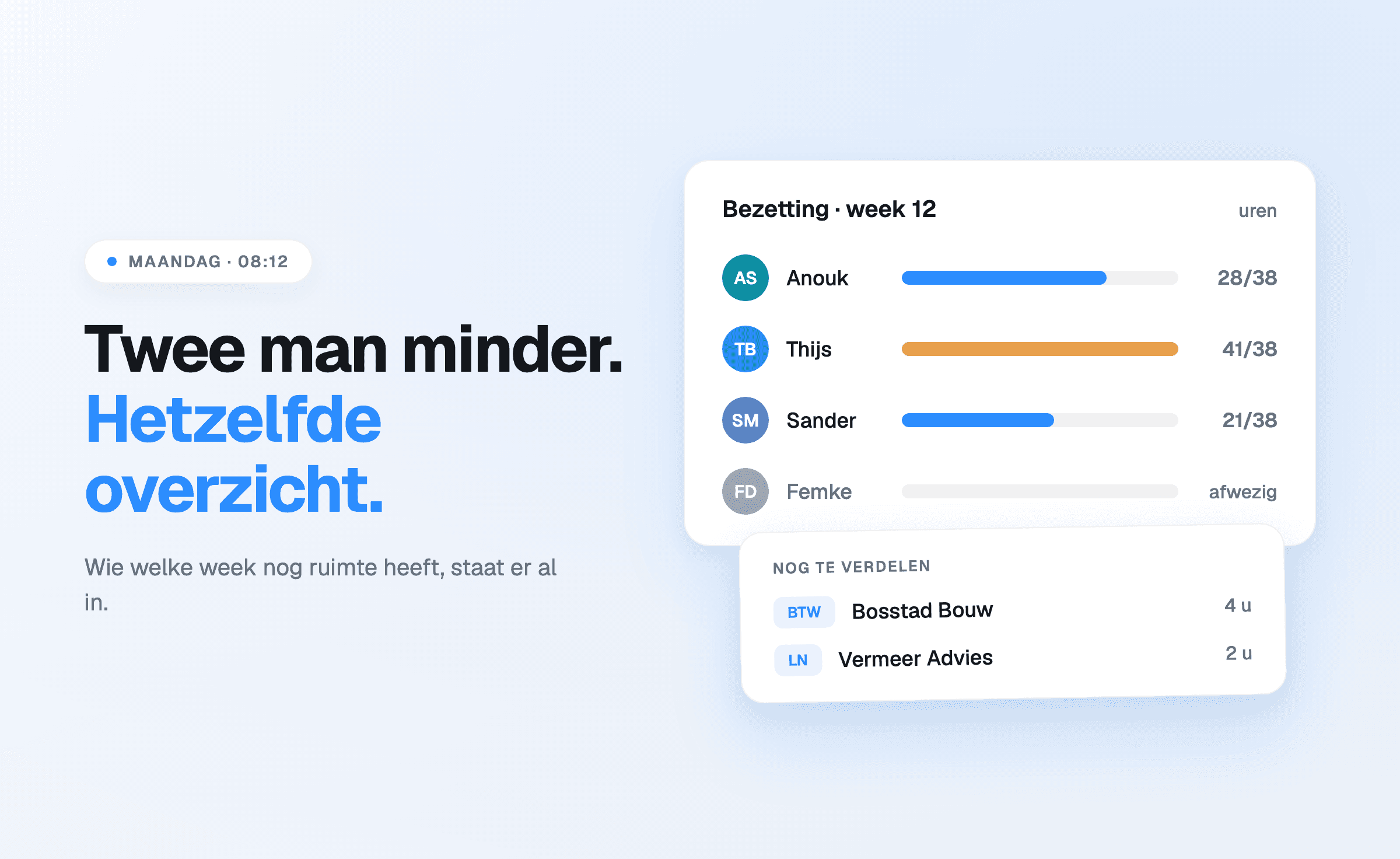
Monday morning, quarter past eight. Two sick notes in a team of six. The question that follows is
never "how many hours are we down" — that is quickly calculated. The question is: which work was
sitting with those two this week, what genuinely has to be finished, and who can take it over
without something else falling over.
At a firm where the planning lives in a spreadsheet, answering that takes a morning. At a firm
where work is planned per employee and per week, it takes fifteen minutes.
Why absence hits a small team so hard
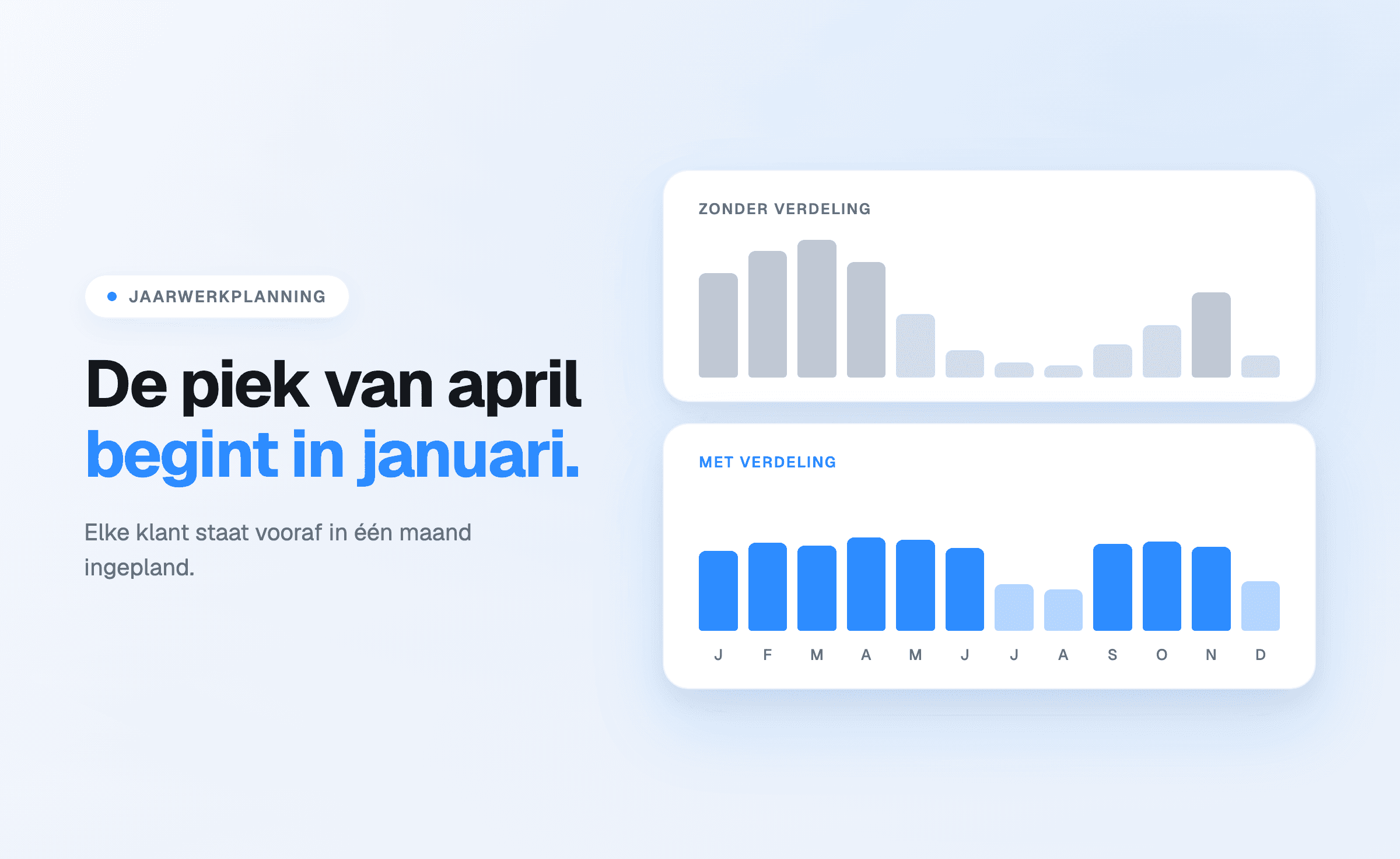
In a team of twenty, one absent colleague is about five percent of capacity. In a team of six it
is seventeen percent, in a week that was probably already ninety percent booked. There is no
buffer to absorb it; the work has to go somewhere else.
On top of that, knowledge in a small team is tied to people. The assignee on a file is often also
the one who knows the client, knows which documents are still missing and why the previous return
deviated. Handing work over therefore means handing context over — and that context is rarely
written down anywhere.
What redistribution requires
Redistribution only works when three things are visible at the same time.
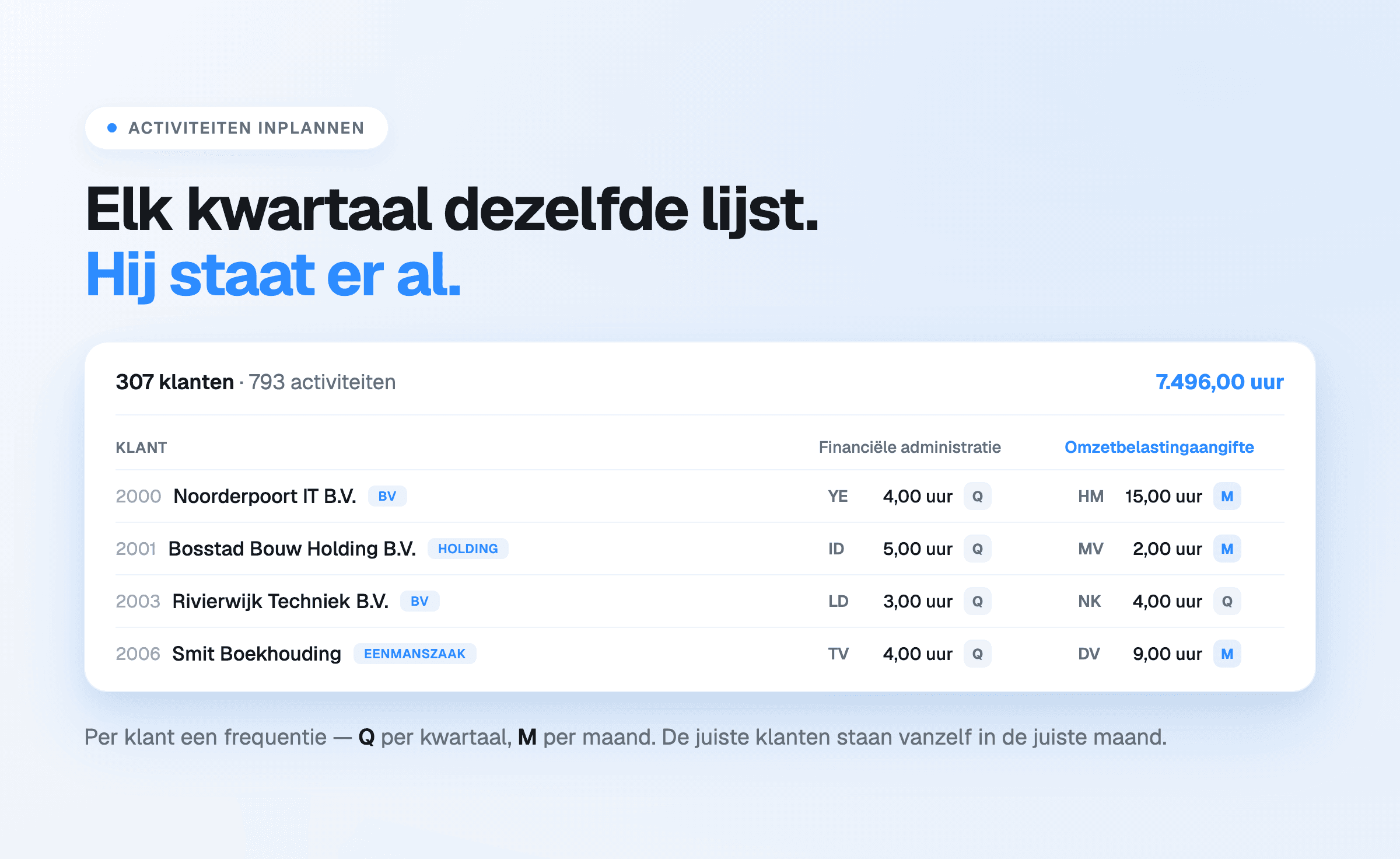
What was planned. Not "Anouk does the VAT", but per client which activity is open this
period, what status it is in and how many hours were set against it. Without that level of
detail, the only form of handover is a conversation.
Who has room. Planned hours per employee set against available hours for that week —
contract hours minus leave and absence. Only then is it clear whether someone can genuinely take
on four more hours or was already over their week.
What can wait. Not everything planned for this week has to be finished this week. A year-end
file with an internal milestone in September is a different matter from a return with a statutory
date. That distinction has to come from the planning itself, not from someone's memory.
Redistributing a week, step by step
- Filter on what is open this period for the absent employees. That is the list in question;
everything else can stay where it is.
- Set the hard dates apart. Returns with a statutory deadline and commitments already made
to clients come first.
- Look at the rest of the team's staffing. Whoever sits below their available hours can take
work over; whoever is already above them does not qualify — not even "quickly".
- Reassign the activities to another assignee. The checklist of steps, the status and the
timeline of earlier remarks come along, so the person taking over can see what has been done.
- Move what can move to a later period, and record why. A file pushed forward without a
reason usually gets pushed forward again.
- Let the account manager inform the clients whose planning changes. That is the step that
turns absence from an internal problem into a managed one.
The whole exercise turns on one thing: that the planning is still correct afterwards. A
redistribution that only exists in two people's heads is gone again the following week.
Holidays are absence known in advance
Illness cannot be planned; holidays can — and yet summer causes the same imbalance at many firms.
That happens because leave and work distribution live in different systems: leave in an HR
overview, planning in a spreadsheet. Putting them side by side shows in May which weeks in July
are too full.
In Offsoo, leave, absence and overtime sit with time tracking, and planned hours sit in the planning grid. The difference between available and planned can
therefore be read per month or per week, well before the week in question starts.
What is left afterwards
Two things are worth reviewing after a busy period.
The ratio between planned and recorded hours shows whether the estimate held. If an activity
structurally takes more time than it is given, that is not an incident but a planning error
repeating itself every period.
Structural overbooking becomes visible as soon as several periods sit side by side. An
employee above their available hours in four months out of six has not been unlucky with absence
— there is simply too much work there.
What software does not do here
This is not automatic redistribution. Offsoo does not move tasks by itself and does not decide
which file can wait; that judgement stays with the firm. What it does do is put the three things
needed for it in one place: what is open, who has room, and how many hours stand against it.
What changes most is the pace. A sick note on Monday morning stays inconvenient, but it costs
fifteen minutes instead of a morning, and the chance of a file falling through the cracks gets
considerably smaller.
Start a free 14-day trial or book a
demo.