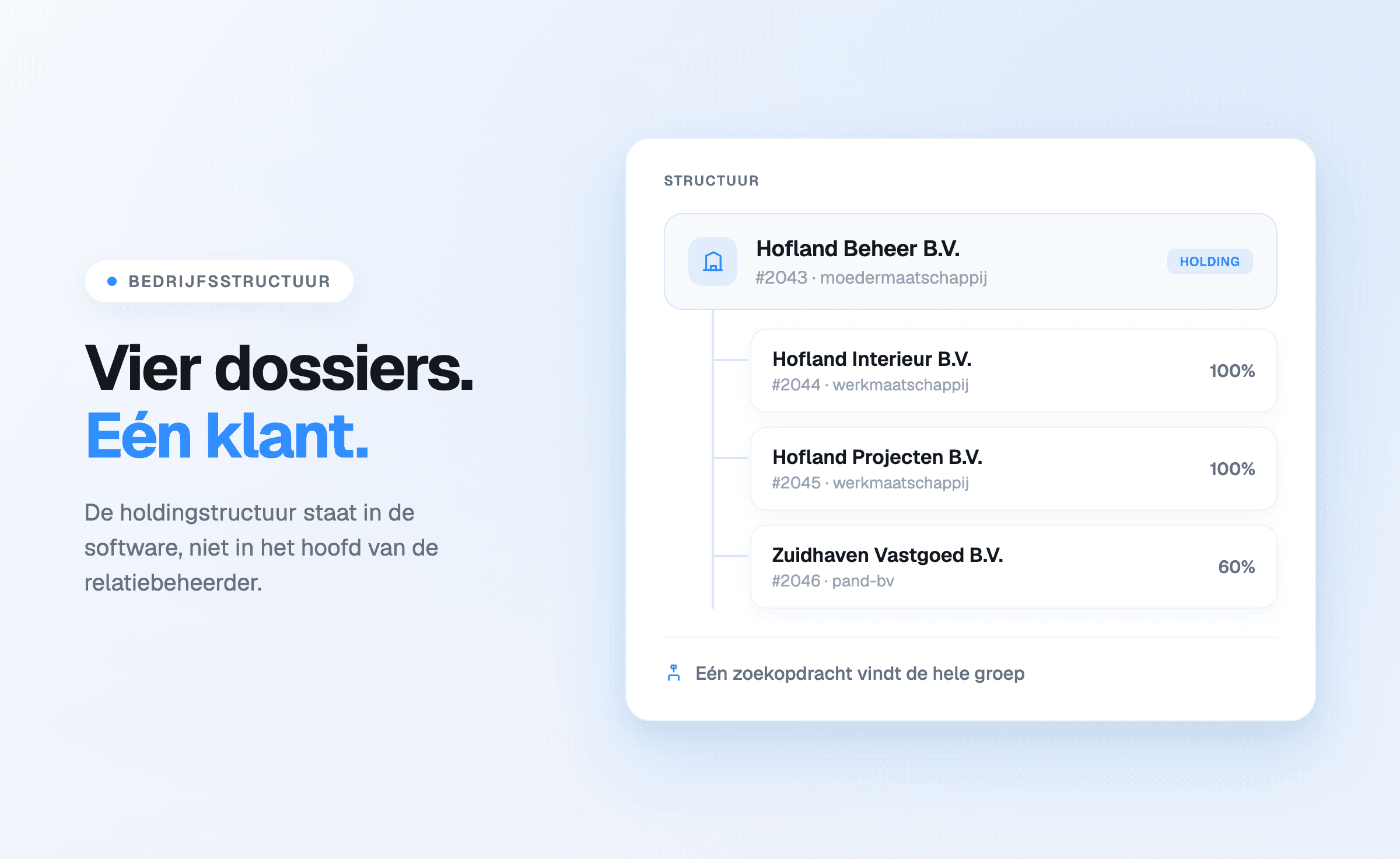
A firm talks about "the Van Dijk client", but in the records that is a holding company, two
operating companies and a property BV. Four files, four sets of annual accounts, four VAT returns —
and one director on the phone asking how it is going.
As long as those four sit separately in the system, the answer to that question lives only in the
account manager's head. Anyone taking over sees four names that happen to look alike.
What goes wrong without structure
The problem is not that the files are missing. They are all there. The problem is that nothing
records that they belong together.
- There is no overview per client. To see whether "Van Dijk" is finished, someone has to walk
four files.
- Work at a subsidiary drops out of sight. The holding company is done, so it feels done —
while the smallest BV is still open.
- Search returns the wrong thing. Searching the holding name turns up the holding, not the
company underneath it where the work sits.
- The knowledge is personal. It leaves with a holiday or a resignation.
What a hierarchy records
In Offsoo a client is linked to a parent client: when editing the client, under the Business structure heading.
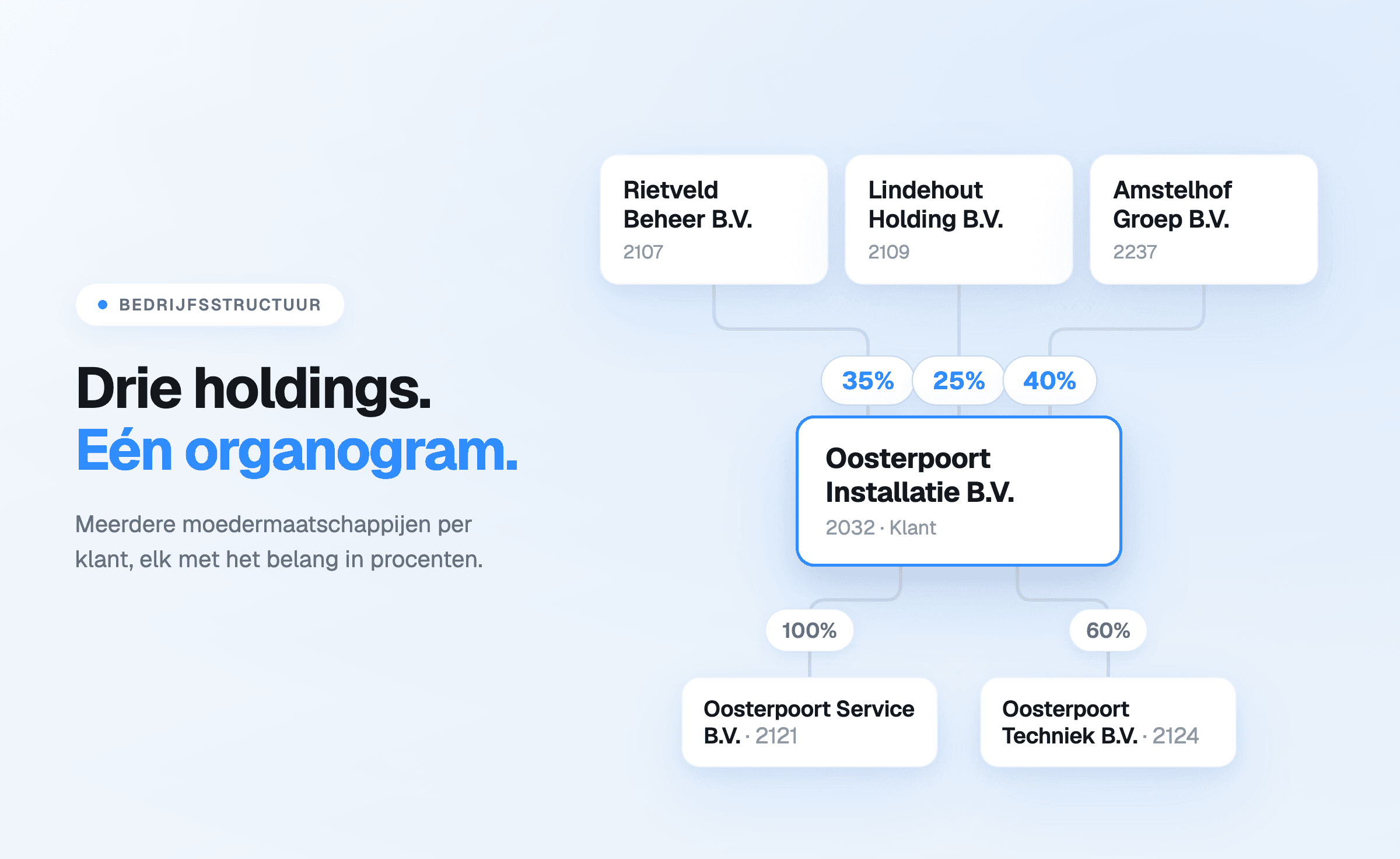
Recently that can also be multiple parent companies, each with its ownership percentage. From then on the structure lives in the software
rather than in an email signature or a spreadsheet tab.
What changes after that:
The org chart on the client card. The client file
shows the whole group as a diagram, with the shareholding percentages between the companies. Anyone
opening the file sees at a glance where this entity sits.
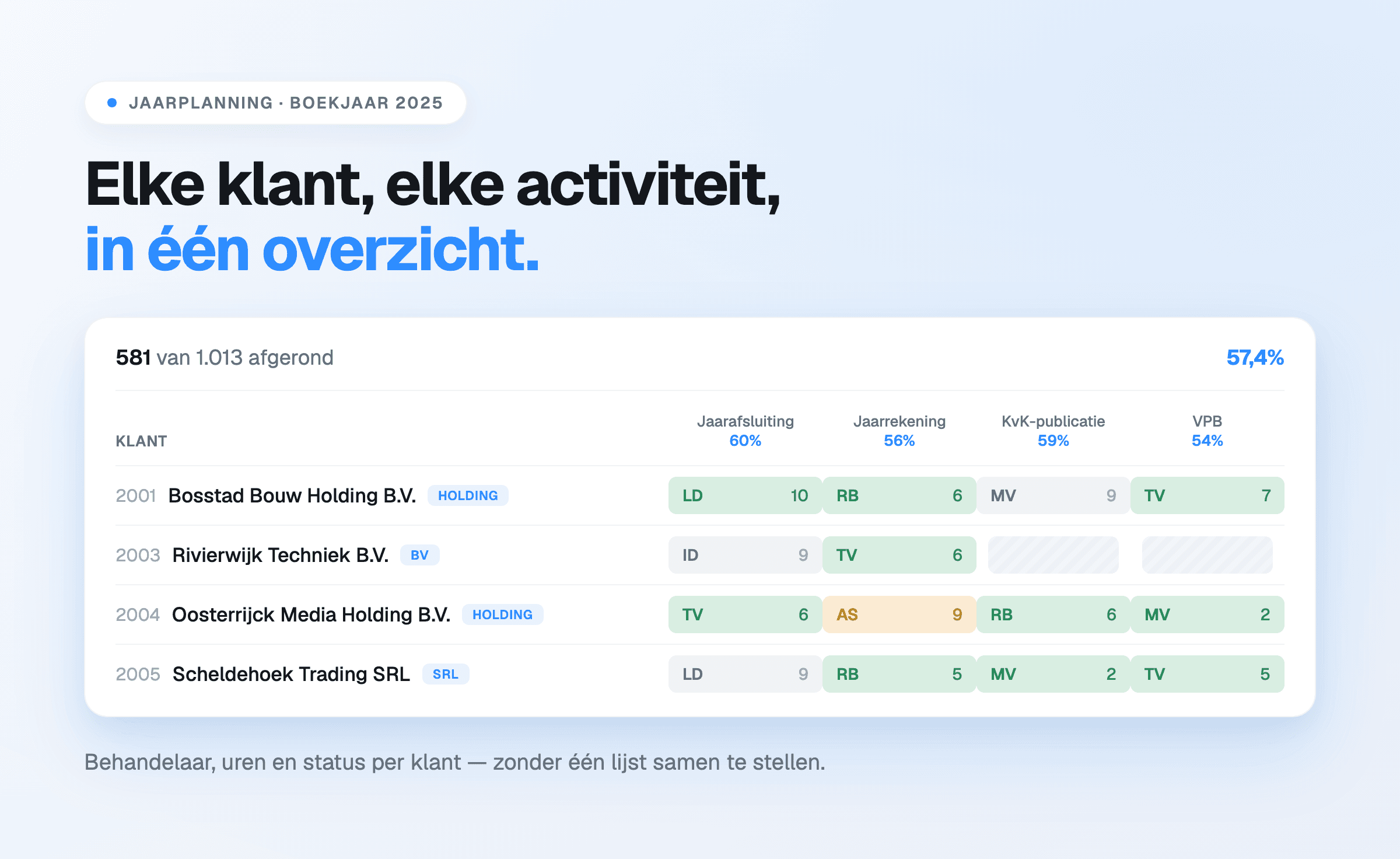
The planning groups along with it. On the monthly and
annual planning boards, subsidiaries are indented
under their parent instead of scattered alphabetically across the board. A group's year-end work
then reads as one block of work, rather than four separate lines that happen to touch.
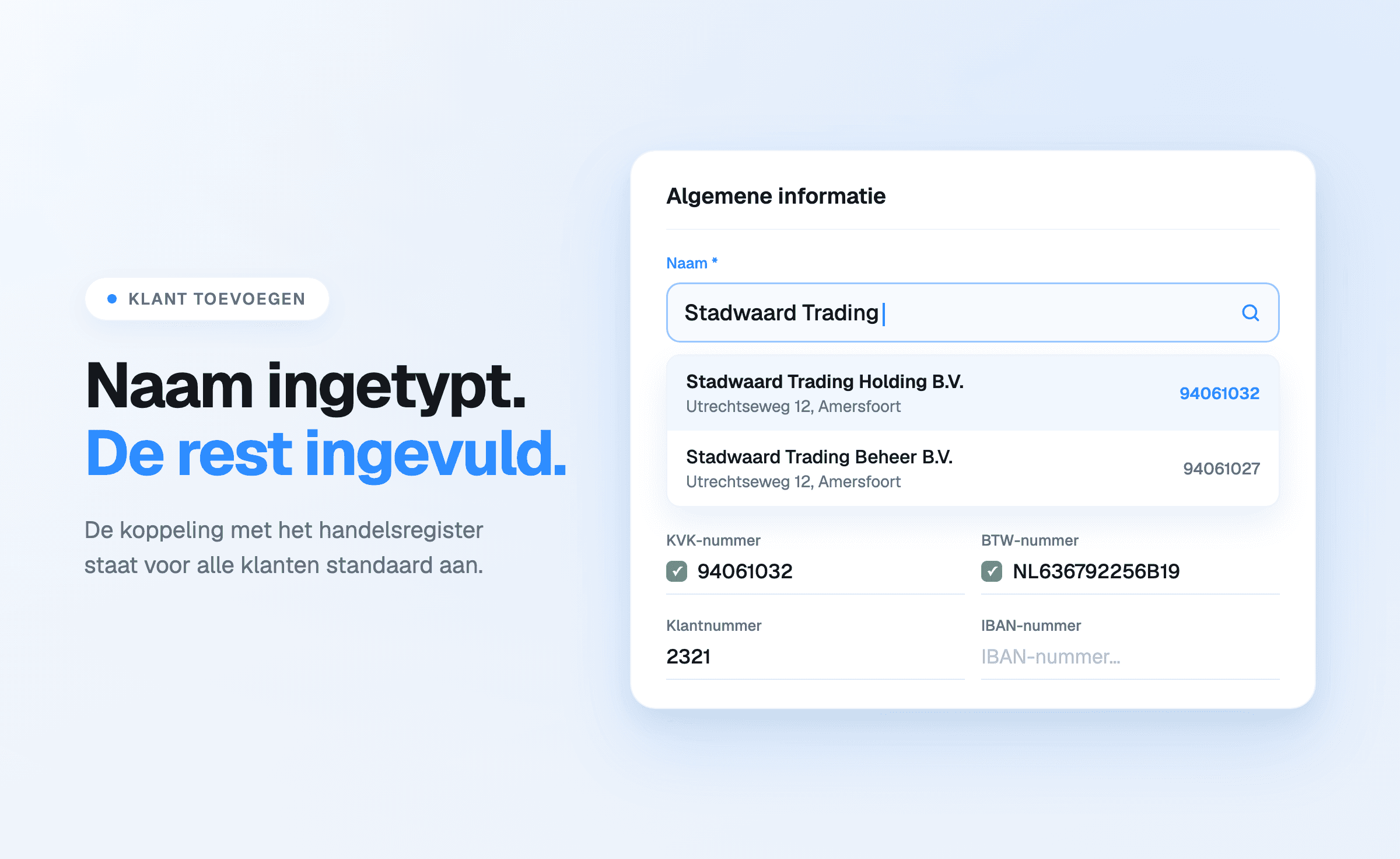
Search runs through the structure. Searching the holding name also returns the companies below
it. That matters most on the phone, when a client mentions a name that is not the name the file is
filed under.
Where it matters most
Not every firm needs this. A client base of sole traders and standalone companies works perfectly
well without it. The structure starts to pay off with:
- clients made up of several companies;
- groups with multiple branches under one name;
- firms where several colleagues work on the same group;
- handovers: a new account manager who has to learn the group.
What it does not solve
The hierarchy says who belongs to whom. It says nothing about what needs doing. Activities,
deadlines and owners stay with each entity, because a subsidiary has its own return and its own
deadline. Offsoo does not merge files, and it does not add up hours or budgets across a group.
What it does do is stop work at the smallest BV of a large client from dropping out of sight —
exactly the work that only gets noticed when the deadline is nearly up.
Start a free 14-day trial or take a look at
client management.