monday.com ends up on nearly every work-management shortlist, including at accounting and
bookkeeping firms. That is no surprise: the platform is visually strong, broadly applicable and
quick to set up. The question is not whether it works, but how much a firm still has to build
around it before it fits the actual practice.
What monday.com is strong at
monday.com is a generic work-management platform. Work lives in boards with columns, and those
columns are freely configurable: statuses, dates, people, formulas, dependencies. Around that sit
views such as timeline and calendar, automations and connections to other systems.
That freedom is the strength. A firm can fit a marketing calendar, a hiring process and an office
renovation into it, all in the same environment. For work that is organised differently every
time, that is exactly what is wanted.
What an accounting firm has to configure alongside it
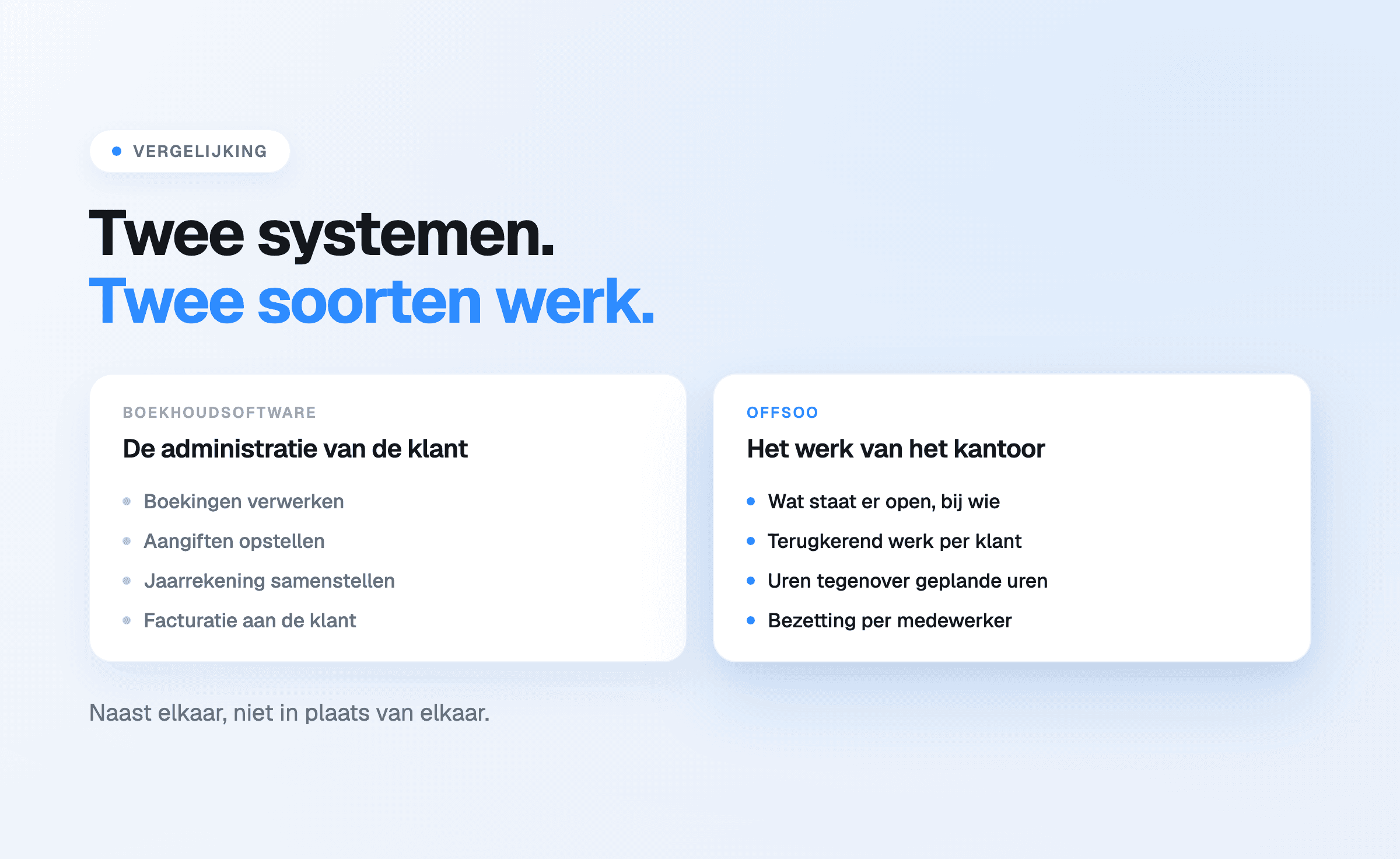
With accountancy work the opposite applies: the work is the same every period. And that is where
the freedom of a generic platform becomes something that has to be maintained.
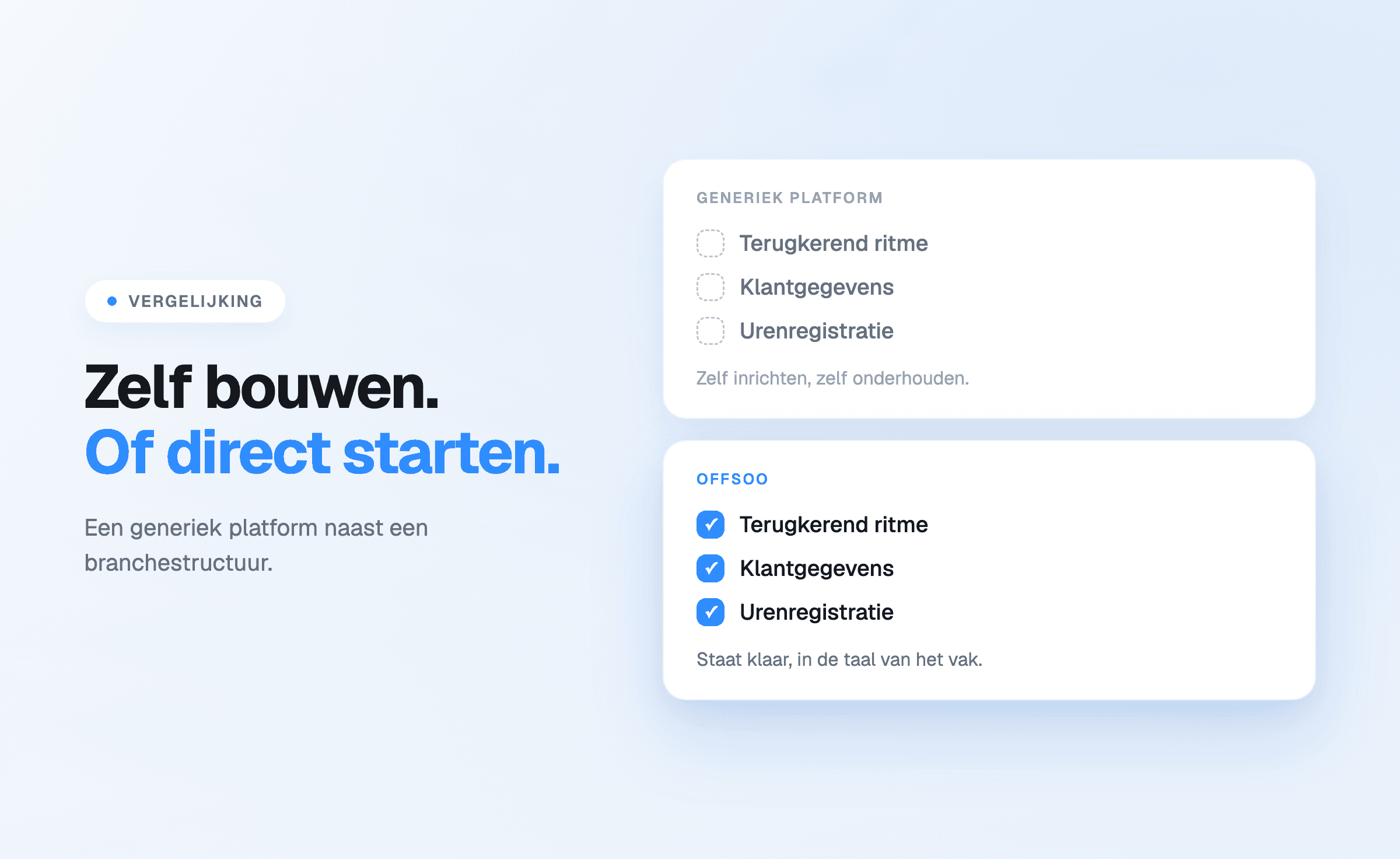
- The recurring rhythm. VAT per quarter, payroll per month, year-end per year, with a
frequency and exceptions per client. That can be rebuilt as a board, but it stays a construction
someone has to manage.
- The client data. Addresses, contacts and registration details have to come from elsewhere
and be kept current by hand.
- Time tracking. Available as an add-on or through an integration, not as a self-evident part
of the same file.
- The vocabulary. Assignee, account manager, activity, filing period: terms that have to be
entered as column names and given meaning again on every board.
None of these points is insurmountable. Together they do determine how much time goes into
maintenance, and how dependent the firm becomes on the one colleague who built the boards.
What Offsoo starts from
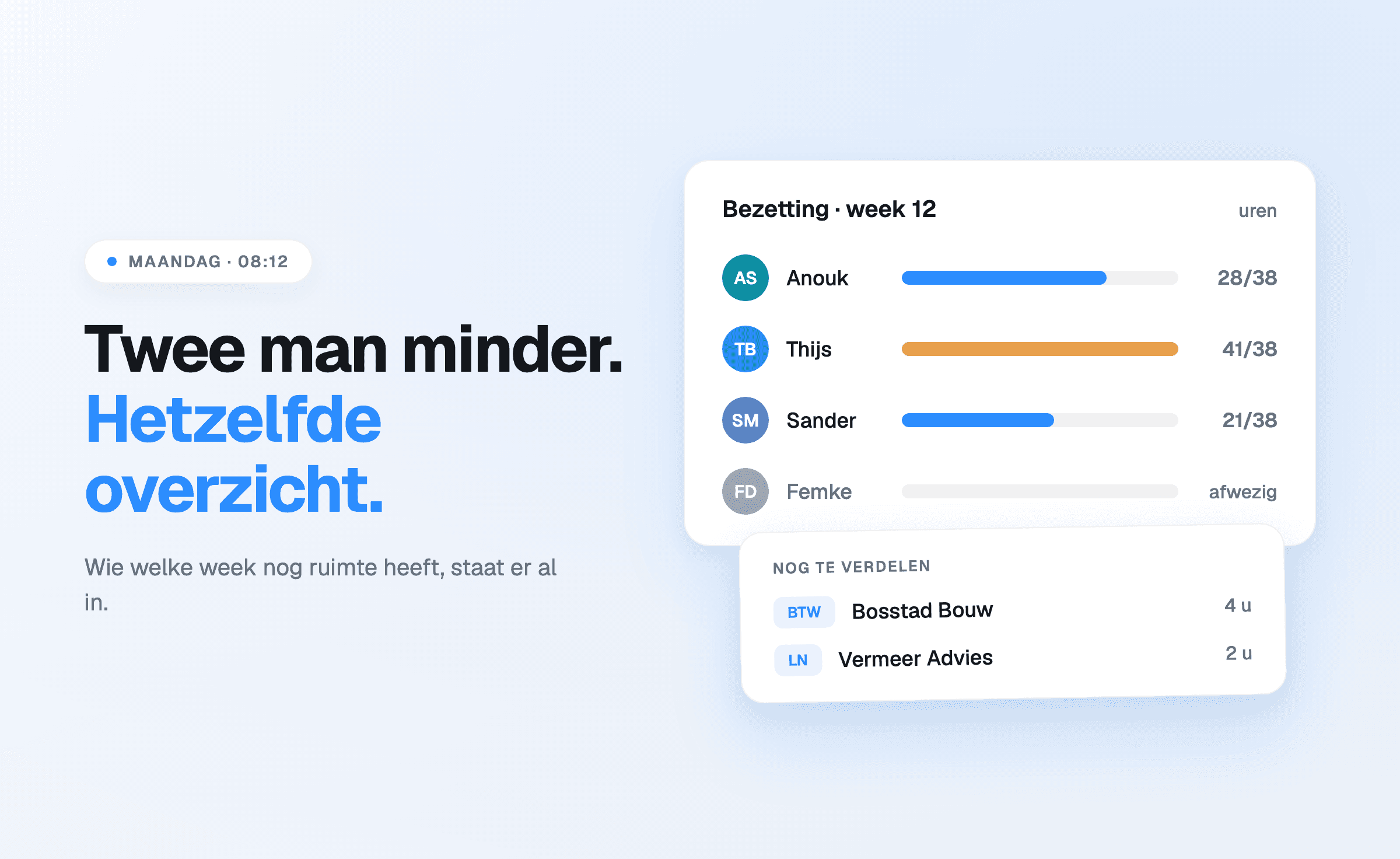
Offsoo starts at the other end: with the work that recurs in a bookkeeping practice anyway. The planning grid is a matrix of clients and activities with a frequency,
an assignee, planned hours, a status and a checklist of steps. Time tracking and client management sit in the same environment, and the KVK connection keeps
clients' basic details current.
That means less freedom — a marketing calendar does not belong in it — and more that is already in
place.
One example: the quarterly VAT round
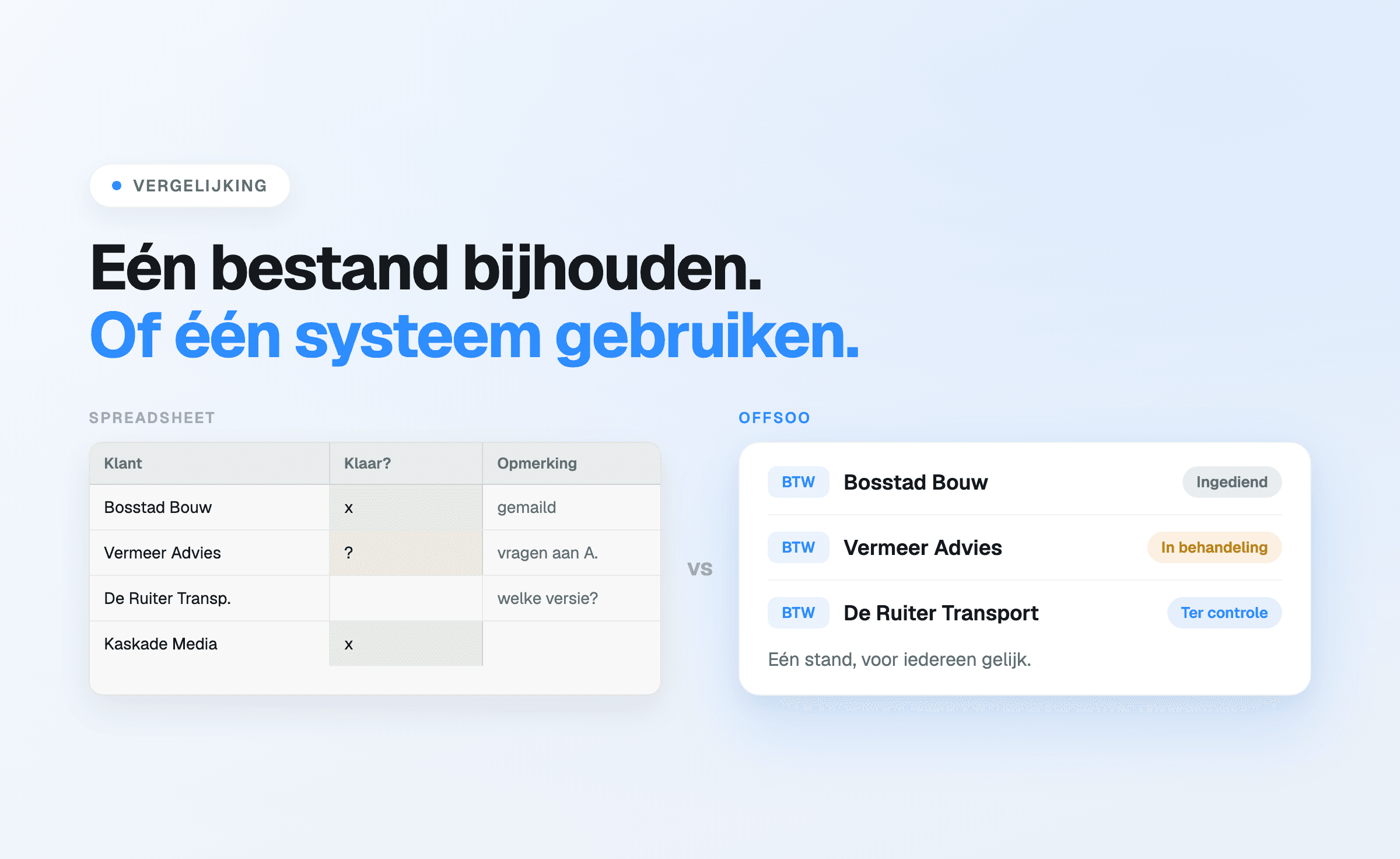
In a generic platform, the round becomes a board: clients as rows, a status column, a date
column, an automation to create a new series each quarter. Client data lives elsewhere, hours live
in a third system, and the exceptions (monthly filers, VAT groups) become remarks in a column.
In Offsoo it is an activity that recurs per client at the right frequency. What is open is a
filter, the assignee and the checklist come along, and recorded hours sit with the same activity as the
planned hours.
The result is not that the work disappears, but that there is less switching between systems and
less to maintain.
When monday.com is the better choice
There are situations where a generic platform simply fits better:
- when the firm runs many projects with their own shape alongside the fixed work — advisory,
interim, implementations;
- when there is a need for custom dashboards and automations that differ per team;
- when someone enjoys building and maintaining that configuration;
- when the work spans several disciplines with little connection to the tax calendar.
When Offsoo fits better
- when the majority of the work is recurring and periodic;
- when planning, hours and client data need to sit in one environment;
- when employees have to work in professional vocabulary straight away, without a board layout
being explained first;
- when the firm wants to grow without its administration growing with it.
The practical test is simple: how much of next quarter's work is already fixed in type, client and
frequency? If that is most of it, a ready-made industry structure is usually cheaper to maintain
than a self-built one.
Start a free 14-day trial or book a
demo to hold it up against the firm's own way
of working.